
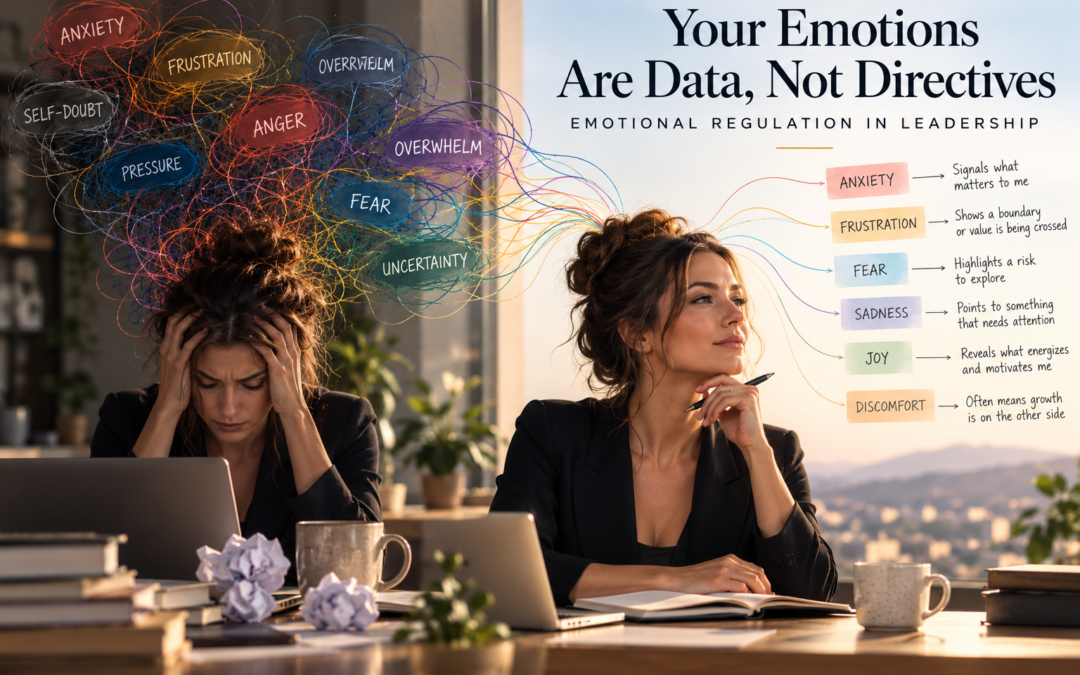
Many leaders were taught that professionalism means keeping emotion out of the room. Stay calm. Stay rational. Don't let feelings cloud your judgment.
It sounds like strength. In practice, it is often suppression, and suppression is expensive.
In my work with founders and senior leaders, the problem is rarely too much emotion or too little. It is unexamined emotion. Emotional regulation in leadership is not about feeling less. It is about knowing what you feel, understanding what it is telling you, and still choosing your response deliberately.
Why "Leave Your Emotions at the Door" Doesn't Work
Neuroscientist Antonio Damasio studied patients with damage to the brain regions that connect emotion to reasoning. Their intelligence and logic were intact. Yet they struggled to make even simple decisions, sometimes deliberating at length over something as minor as when to schedule an appointment. Without emotional signals marking some options as better than others, reasoning alone stalled.
The lesson for leaders is significant. Emotion is not the opposite of good judgment. It is part of how good judgment works. Leaders who try to remove it don't become more rational. They lose access to information.
What Your Emotions Are Actually Telling You
Emotions are fast, compressed assessments of what is happening around you. They often register something before your conscious mind has put it into words.
Irritation in a meeting may signal that a boundary or a value is being crossed. Unease about a deal that looks good on paper may be pattern recognition you haven't yet articulated. Dread before a conversation often means something important has been avoided for too long. And anxiety around delegation is frequently less about the other person's competence than about what letting go of control feels like.
None of these tell you what to do. They tell you where to look.
The Hidden Cost of Suppression
Research led by psychologist James Gross and colleagues at Stanford has examined what happens when people suppress emotion rather than work with it. Suppression does not make the feeling go away. Physiological stress stays elevated, and people remember less of the conversation they were in. In one study, the conversation partners of people who were suppressing felt less connected to them and showed higher blood pressure themselves.
Translate that into leadership. Your team reads you as guarded, even when you believe you are projecting calm. Trust erodes quietly. And the emotion leaks out anyway: in a sharper email, a shorter fuse at the end of the week, or a decision made mainly to end your own discomfort. Leaders who are good at emotional regulation are able to recognize the emotions they are feeling and separate their emotions from their behaviors. They are treated as separate entities within us. Emotional regulation in leadership is an essential skill, not just an option.
The Opposite Problem: When Emotion Takes the Wheel
Suppression is only half the risk. Under pressure, emotion can also take over.
Fear becomes overcontrol. Frustration becomes a punitive decision. Anxiety pushes leaders to decide too quickly just to escape uncertainty, or to avoid deciding at all. In each case, the emotion stops being information and starts being the decision-maker. This is why emotional regulation in leadership can be a make or break skill.
Emotions deserve a seat at the table. They just shouldn't be the ones running the meeting.
What Emotional Regulation in Leadership Looks Like
Regulation is a skill, and like any skill it can be built. It comes down to four moves.
Notice it. The body usually knows first: a tight chest, a clipped tone, the urge to interrupt. Learn your early signals.
Name it precisely. Multiple research studies have found that simply putting feelings into words reduces activity in the brain's threat response. In the words of Brené Brown "If you can name it, you can tame it". Precision matters. "Frustrated" and "overlooked" point to very different problems. On average, American adults use three words to describe their emotional experiences: Mad, sad, and glad (or variations thereof). However, our emotional experiences are much more complex than these words allow. Having a diverse emotional vocabulary can help us name them more accurately and give us a sense of control over something that often feels so out of control.
Ask what it's signaling. Is this about the current situation, or is it an old pattern being activated? Pressure has a way of making old patterns louder.
Choose deliberately. Given what I feel and what I know, what response serves the outcome I actually want?
This is where emotion becomes an advantage. Leaders who can do this consistently make clearer decisions, handle conflict with more steadiness, and build teams that trust them.
A Practice for This Week
Before your next high-stakes decision or difficult conversation, take sixty seconds and ask yourself:
What am I feeling right now? What might it be telling me? What would I do if I acted directly from it? What will I choose instead?
It is a small habit with a large return.
The Bottom Line
Strong leadership is not the absence of emotion. It is the ability to use emotion well. Emotions are not weakness. Acting unconsciously from them is.
This is the work I do with founders and senior leaders in Individual Advisory: understanding what drives you under pressure so you can think clearly, decide well, and lead from a steadier place. If you're ready for your next level of success, inside and out, I'd be glad to talk.
Danielle McGraw, Ph.D. is a clinical psychologist and psychological advisor to founders, executives, and high-performing professionals.