
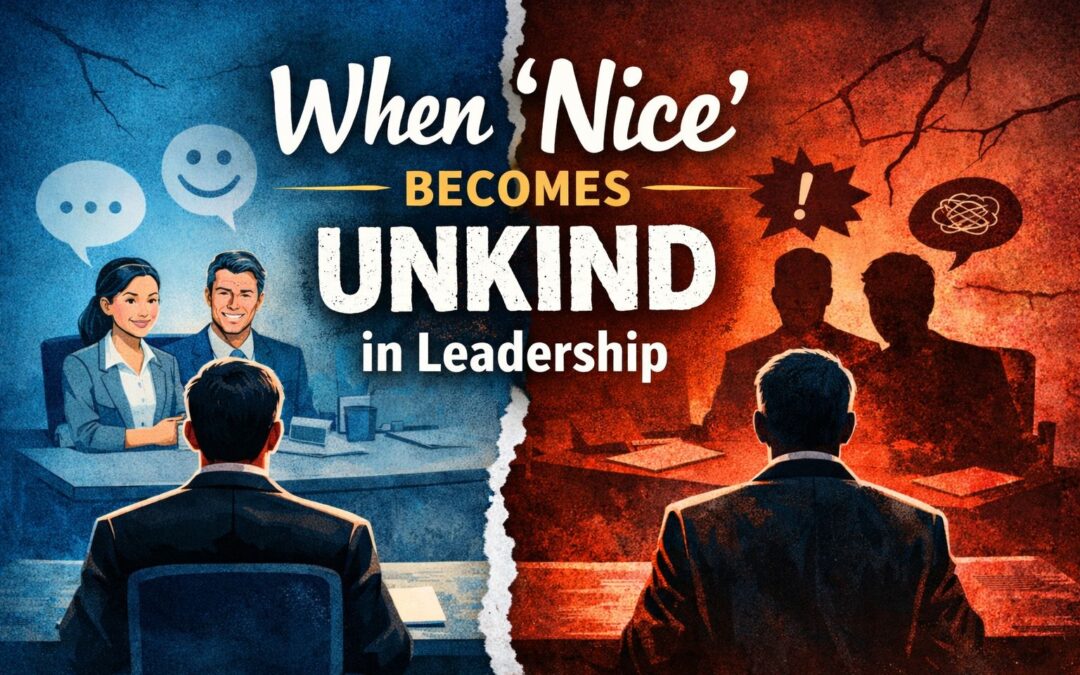
Kind leadership gets mistaken for niceness all the time, and the confusion quietly costs teams more than most leaders realize.
The Hidden Cost of Being Nice
When people talk about leadership pressure, they usually talk about workload. But one of the hardest parts of leadership is quieter, and rarely named: the higher you rise, the less honest feedback you get.
Not because people are bad. Not because your team is hiding things. But because power changes conversations.
People become more careful. They filter more. They soften things. They wait longer to tell you when something feels off. And over time, that creates risk, because now you're making decisions in an environment with less friction, less challenge, and less truth.
That's not just a business problem. It's a psychological one.
What Happens When Honest Feedback Disappears
When leaders stop receiving direct, thoughtful feedback, a specific pattern emerges. They start to feel:
- More isolated
- Less certain about what people really think
- More vulnerable to overconfidence or self-doubt
- Increasingly disconnected from reality while still appearing "in control"
This is the paradox of seniority. The more responsibility you hold, the more you need accurate information, and the less accurate the information around you tends to become. Comfort replaces clarity. Agreement replaces insight. And the leader, often the last to notice, keeps making decisions based on a version of reality that has been quietly smoothed for their consumption.
Clear Is Kind. Unclear Is Unkind.
Brené Brown popularized the idea that clear is kind, unclear is unkind. In leadership, this principle becomes operationally important.
Too often, people avoid direct feedback in the name of being "nice." But what feels nice in the moment often becomes unkind over time. Because when honest, thoughtful feedback is withheld, what usually follows is:
- Confusion
- Misalignment
- Delayed course correction
- Unnecessary frustration on both sides
Niceness protects the feedback-giver's comfort. Kindness protects the relationship, the person, and the work. Avoidance is not kindness dressed in better clothes.
Kind leadership is not vague. Kind leadership is clear. It says: here is what is working. Here is what is not working. Here is what needs to change. And it delivers that feedback with honesty, respect, and care.
Why Leaders Must Also Make Honesty Safer
The same principle works in reverse, and this is where most leaders underinvest.
One of the most important things a founder or CEO can do is create conditions where honesty is safer than agreement. Not just my door is always open. Real conditions.
People around you need to know that:
- Thoughtful disagreement won't be punished
- Bad news can be brought early without consequence
- Honesty won't damage trust
- Kind, skillful candor is part of the culture, not a threat to it
This is psychological safety in its most practical form. It's not about being soft. It's about designing a feedback environment where reality can still reach the top.
Because leadership is not just about vision. It's also about creating enough psychological safety around you that reality can still reach you.
The Leadership Standard Worth Holding
The leaders I work with who navigate this well share one quality: they treat clarity as an act of respect, not confrontation. They understand that withholding honest feedback isn't protection. It's avoidance dressed up as politeness. And they build cultures where people don't have to choose between being liked and being useful.
Clear is kind. Especially in leadership.
If this resonates, I work with founders and senior leaders on exactly these patterns: how relational dynamics shape the way we lead, give feedback, and create the conditions for real performance. Learn more about Individual Advisory.